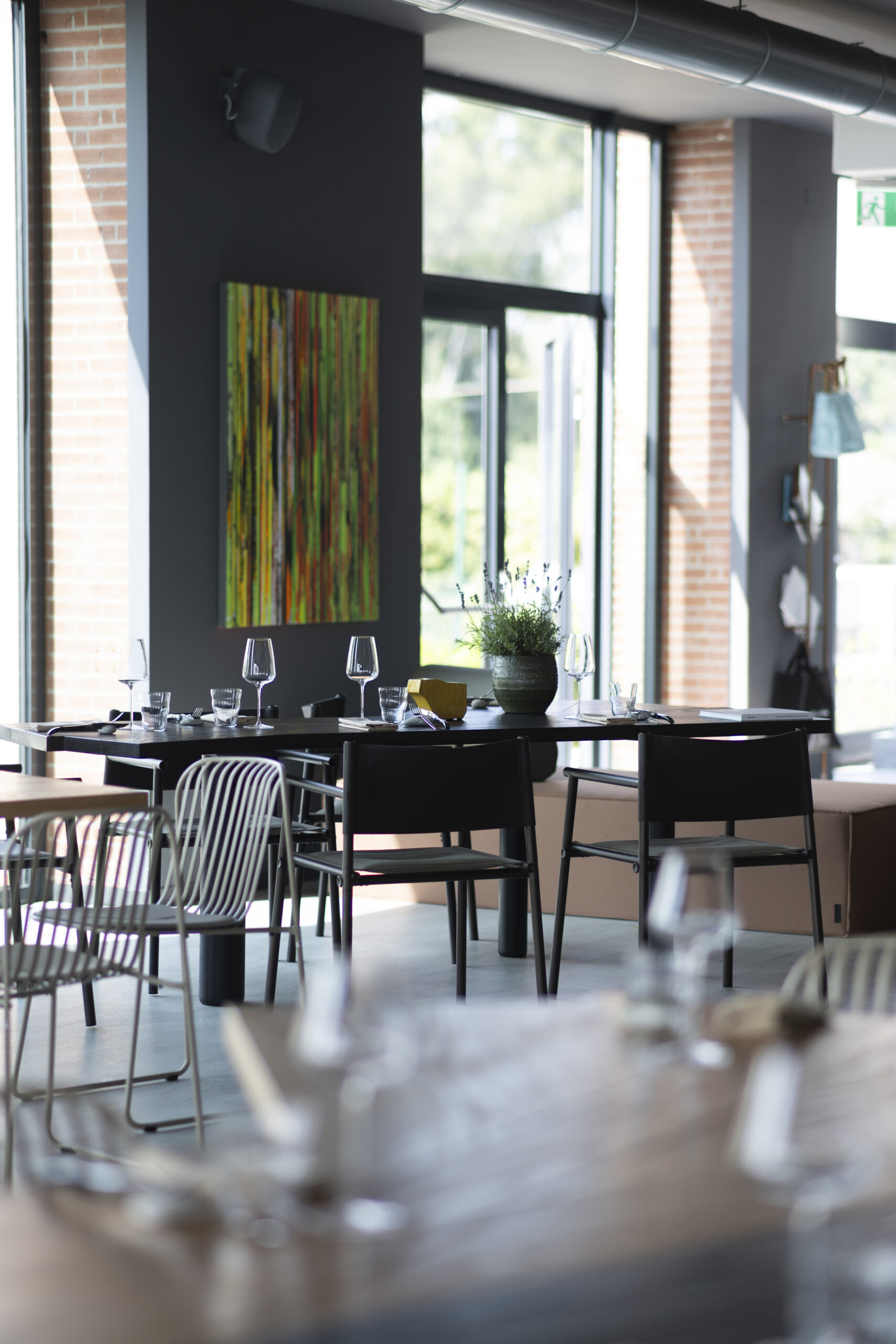
The boundary between the dining room and the exhibition space has become thin. This is not a new affinity, the relationship between cuisine and art has always accompanied the history of catering, but in recent years that relationship has taken a more explicit and structured form: temporary exhibitions inside restaurants, design objects that permanently enter the furnishings, dishes conceived as the gastronomic translation of a work.
The room as a temporary exhibition space
A clear signal comes from the large contemporary art fairs, which in recent years have started to take works out of the pavilions. On the occasion of Miart in Milan, the Ambasciatori del Gusto association collaborated with the fair to exhibit, for the duration of the event and coinciding with the Design Week, some works of the Fiera Milano Foundation in ten restaurants in the city, each paired with a dish designed to dialogue with the hosted work. The exhibition thus moves from the white cube to the room, with an audience that meets it between one course and another.
A similar path followed the pArt project, which involved restaurants in Milan, Florence and Rome, linking themed dinners to restoration initiatives of the Italian artistic heritage: in this case the menu also becomes a concrete support tool for the conservation of the works.
The restaurant as a permanent collection
Alongside temporary initiatives, the number of venues that choose to permanently host art and design collections is growing. Dina, Alberto Gipponi's restaurant-museum in Gussago, was born from the collaboration with the gallery owner Massimo Minini: the walls host works by Francesca Woodman, Ariel Schlesinger, Nedko Solakov, alongside pieces from the chef's personal collection. Design enters the same space naturally: the Parentesi lamp by Achille Castiglioni and Pio Manzù, le Bon Jour by Philippe Starck, and a line of Ergonomica cutlery designed by Angelo Mangiarotti, present in only one Italian restaurant.
Massimo Bottura's Osteria Francescana has also strengthened its museum dimension over the years, with a restyling of the spaces carried out together with the lighting designer Davide Groppi and works by Maurizio Cattelan, Gavin Turk, Grazia Toderi integrated into the layout of the room. The distinction between a restaurant and a container of contemporary art, in these cases, ceases to be clear.
The dish as a translation of a work
However, the most direct meeting point between the two disciplines remains the dish itself, conceived as a gastronomic reading of a visual work. Gualtiero Marchesi built part of his cuisine on this principle, with creations directly inspired by artists he had known or frequented: the monkfish in squid ink and tomato sauce, designed as a tribute to Lucio Fontana, is a recurring example.
More recently, the Unconventional Food For Art project by chef Paolo Griffa, developed in collaboration with the Ruinart maison, translated the series of works created by the British artist David Shrigley during an artistic residency into an entire menu: each course followed the visual and conceptual logic of the original work, down to a plaster element to be broken before accessing the dish, a gesture that physically replicated the act of unveiling typical of a performance.
A trend with long roots, more visible today
The encounter between table and art has a history that precedes these examples. The Colombe d'Or in Saint-Paul de Vence preserves works by Picasso, Matisse and Modigliani left by the artists who frequented the place; the Kronenhalle in Zurich displays paintings by Kandinsky and Klee alongside tables by Alberto Giacometti; the Four Seasons in New York also went down in history for Rothko's work which never reached its walls, returned by the artist himself and today preserved at the Tate Modern.
What has changed in recent years is the systematic nature of the phenomenon: no longer isolated episodes linked to the personal taste of an owner or the generosity of a passing artist, but structured, calendarized projects, often built in partnership between cultural institutions, galleries and catering establishments, with the design object accompanying the pictorial work as an integral part of the same story.
Design as a third element
If the temporary exhibition brings art into the room and the dish translates it into the language of the kitchen, the design object completes the most discreet and lasting step: it enters daily use, in the cutlery, in the seat, in the light, remaining present well beyond the duration of an exhibition or a seasonal menu. It is in this intermediate space, between the temporary nature of the exhibition and the permanence of the furniture, that contemporary catering is building a new way of experiencing beauty, without having to separate it from the gesture of sitting at the table.